Eutychius of Alexandria—Sa‘id b. al-Bitriq (c. 877–940 CE)—was a Christian Arab patriarch, physician, and historian who lived under Abbasid rule, mostly in Baghdad and later in Fustat (Old Cairo). As patriarch of Alexandria in the Melkite (Chalcedonian) tradition, he stood at a crossroads of Greek, Syriac, Coptic, and Arabic Christian thought, while also interacting with the dominant Islamic intellectual world around him. His major work, usually called the Annals (Kitāb al-Taʾrīkh al-Majmūʿ ʿalā l-Taḥqīq), is a universal history running from creation up to his own day, written in Arabic for a Christian audience that had to think in conversation with both Scripture and the Qur’an, with Jewish traditions and Greek philosophy.
Within that sweeping history, Eutychius pauses over Genesis 4–6 and offers a vivid, extended retelling of the lead-up to the Flood. There, he treats Genesis 6:1–4 as a story not about angels, but about the human descendants of Seth (the “sons of God”) leaving a holy mountain, marrying the daughters of Cain, and producing giants. This puts him squarely in the “Sethite” school of interpretation, though he develops it in his own unique way. His account survives in Louis Cheikho’s edition of the Annals (CSCO 50, 8.22–10.4) and has been translated and discussed by modern scholars such as John Reeves (see his translation and notes here). Reading him alongside Genesis 4–6 and the New Testament passages that refer back to the pre-Flood rebellion (especially Jude 6–7; 2 Peter 2:4–5; 1 Peter 3:19–20) gives us a window into how a careful medieval Christian thinker wrestled with a passage that many modern churches simply skip.
For readers wanting a broader introduction to Genesis 6, the “sons of God,” and the Nephilim, see the Tracing the Giants series and the growing database of ancient sources that mention this story.
Eutychius’ Retelling of Genesis 4–6 (Giants, Holy Mountain, and Human “Sons of God”)
Eutychius doesn’t just comment on Genesis 6; he builds a narrative bridge from the genealogy in Genesis 5 to the crisis before the Flood. He starts with Mahalalel and Jared (Yared), tying them into a story of a “holy mountain” where Seth’s descendants live close to God, separated from the corrupt line of Cain.
When Mahalalel is near death, Eutychius says he summons his son Jared and makes him swear a solemn oath:
“When the time of death for Mahalalel drew nigh, he summoned his son Jared and adjured him by the blood of Abel not to allow any of his family to descend from the mountain to (mingle with) the progeny of Cain the accursed murderer.”
That oath “by the blood of Abel” underlines how seriously Eutychius takes the divide between the two lines. Seth’s family dwells on the “holy mountain,” a kind of sacred high place near God’s presence. Cain’s descendants live down on the plain, in a territory marked by bloodguilt and curse.
Eutychius then paints Cain’s descendants in extreme colors. Their men are “like stallions neighing after the women,” and the women pursue the men “shamelessly.” Sexual sin is everywhere and public:
“They were fornicating and wantonly sinning, each with one another, openly and publicly. Two or three men would cohabit with one woman, the old were more depraved than the young, fathers upon their daughters and sons upon their mothers. Children did not recognize their parents nor did parents their children, and they dallied with pagan deities.”
This is more than immorality; it is the collapse of family, identity, and worship. The sound of their cries and laughter, he says, reaches the top of the holy mountain.
That noise sets the crisis in motion. Hearing it, a group of one hundred males from Seth’s line decide to descend and see what is happening:
“Then when the progeny of Seth heard the noise, one hundred of their males assembled together for the purpose of descending the mountain unto the progeny of Cain the accursed. Yared adjured them by the blood of Abel not to descend from the holy mountain, but they would not hearken to his words, and so they descended.”
Once they descend, the attraction is immediate and mutual. The daughters of Cain are “beautiful, being naked (and going about) without shame,” and the sons of Seth are “handsome men, giant-like (jababira).” Eutychius writes:
“They became consumed with desire (for them). So too the daughters of Cain beheld them, (seeing) that they were handsome men, giant-like (jababira), and so they acted as if they were wild animals, and polluted their bodies. Hence the sons of Seth came to ruin through the harlotry of the daughters of Cain.”
The result is the birth of giants:
“And the daughters of Cain the accursed gave birth to giants (jababira) from their union with the sons of Seth.”
Here Eutychius explicitly connects his retelling to Genesis 6:1–4. He notes that the Torah calls these figures beney ’elohim (“sons of God”) and that “it is from them that the giants (jababira) came to be.” But for him, “giant-like” is an exaggerated way of speaking about impressive, powerful humans—offspring of mixed unions between a once-holy line and a degraded one.
Eutychius also adds a striking supernatural detail: once the Sethite men have gone down, they cannot go back up.
“And when those sons of Seth who had descended from the mountain to the daughters of Cain the accursed wished to return to the holy mountain, the stone of the mountain became as fire (to their touch), and so it was not possible for them to return to the mountain. After this more fellow kinsmen began to descend from the holy mountain to the daughters of Cain the accursed.”
The mountain itself becomes a fiery barrier. Descending from the mountain is both a physical movement and a spiritual fall, and the closed way back dramatizes the cost of crossing moral and covenant boundaries. Eutychius’ whole retelling is structured to highlight that movement: from holiness and separation, down into mingling, lust, idolatry, and finally flood-worthy corruption.
Why Eutychius Rejected the Angelic View of the “Sons of God”
After retelling the story, Eutychius turns directly to the question many readers of Genesis 6:1–4 ask: were these really angels? He answers with unusual clarity: no.
On the term beney ’elohim, he writes:
“In the Torah it says that they were ‘sons of God,’ having the name beney ’elohim… But one errs and misunderstands (if) he says that ‘angels’ descended to ‘mortal women.’ Instead, it is the sons of Seth who descend from the holy mountain to the daughters of Cain the accursed. For it was on account of their saintliness (chastity?) and dwelling-place upon the holy mountain that the sons of Seth were called banu ’elohim; that is, ‘sons of God.’”
So for Eutychius, “sons of God” is a title of honor for righteous humans living in God’s special place, not a label for heavenly beings. The sons of Seth lose that status when they abandon the mountain and mix with Cain’s line.
He then lays out a metaphysical argument: angels, by nature, cannot do what Genesis 6 is often said to describe.
“When some say that angels descended unto mortal women, they are in error; for the substance of angels is a simple substance, and sexual plurality (i.e., gender distinction) is not part of their nature, while human beings have a complex substance, (and) sexual plurality forms part of their nature, as so too with all the animals.”
Angels have a “simple” (non-composite) substance, without male and female. Humans and animals have “complex” substances with sex built into their nature. For Eutychius, that ontological difference makes sexual union between angels and humans impossible.
He then pushes the logic to an extreme:
“If angels could have sexual intercourse, there would not be left one virgin from among all human women that they would not defile.”
Here he’s arguing by reductio ad absurdum: if angels were both able and willing to sleep with women, what would stop them from doing so universally? The result would be universal violation, which he sees as unthinkable and incompatible with God’s justice and providence.
[Jake’s commentary:] You can feel the instinct behind his arguments. Eutychius wants to protect God’s holiness, angelic purity, and a clear moral order. Many modern Christians raise similar objections: “Angels don’t have bodies; Jesus said angels don’t marry; this sounds too much like pagan myth.” But Scripture also shows angels temporarily taking bodily form—eating with Abraham in Genesis 18, pulling Lot out of Sodom in Genesis 19—and Jude 6–7 and 2 Peter 2:4–5 speak of angels who “did not stay within their own position of authority” and are now imprisoned in gloomy darkness, in a context that echoes the days of Noah. Whatever we make of Eutychius’ metaphysics, we still have to let those biblical texts speak.
For readers interested in the broader debate over the “sons of God” in Genesis 6—angelic or human?—see overviews such as David Schrock’s survey of three views (link) and Wayne T. Pitard’s “Those Elusive ‘Sons of God’” (link).
Eutychius in the History of Genesis 6 Interpretation
Historically, Eutychius is not inventing the Sethite view, but he is a late and interesting witness to it.
In the centuries leading up to Jesus and the New Testament, the angelic reading of “sons of God” in Genesis 6:1–4 was dominant. Jewish sources like 1 Enoch, Jubilees, Philo of Alexandria, Josephus, and the Qumran “Book of Giants” all understood the “sons of God” as heavenly beings (often called Watchers) who overstepped their bounds and fathered giant offspring. Early Christians followed suit. Justin Martyr, Irenaeus, Athenagoras, Clement of Alexandria, Tertullian, and others all read Genesis 6 as an angelic transgression that helped explain the origin of demons, giants, and certain elements of pagan myth. For a detailed survey of early Jewish interpretation, see Jaap Doedens’ dissertation on Genesis 6:1–4 (link).
The Sethite view surfaces later. Julius Africanus in the 3rd century is the first Christian writer we know who clearly proposes that “the descendants of Seth are called the sons of God… but the descendants of Cain are named the seed of men.” He still felt the weight of the older angelic tradition and hedged his bets. Augustine (4th–5th century) marks the big turning point in the Latin West. In City of God and elsewhere he argues that “sons of God” must be Seth’s line, not angels, partly because he cannot accept that holy angels would commit this sort of sin and partly because he distrusts the apocryphal Enochic traditions.
By Eutychius’ day (10th century), Augustine’s influence had shaped much of Western Christian thinking, and similar trends were at work in Jewish and Muslim circles. Rabbinic Judaism had already shifted toward human readings (“sons of nobles,” “sons of judges”). Within Islam, philosophical theologians were emphasizing God’s transcendence and the incorruptibility of true angels. Figures like Maimonides in medieval Judaism would later argue strongly that angels are purely intellectual beings, not the sort who take wives.
Eutychius, as a Christian Arab scholar steeped in Greek patristic thought and writing in Arabic under Islamic rule, sits in that broader trend. His insistence that angels are “simple substances” without sexual differentiation looks very much like the philosophical angelology that was spreading in the medieval Mediterranean world. His fiery mountain, the graphic portrayal of Cainite depravity, and the highly embroidered story function like a Christian “midrash”—a narrative expansion meant to drive home a moral and theological point, not to replicate Scripture word for word.
For readers wanting to see how Eutychius compares with other ancient and medieval voices on Genesis 6 and the Nephilim, the Commentators section and our research papers on Genesis 6:1–4 gather both primary sources and academic analysis, including work by scholars such as John Day, Robin Routledge, and Loren Stuckenbruck. Some of these studies (e.g., Kio’s “Revisiting the ‘Sons of God’ in Genesis 6:1–4” PDF) track how the debate has unfolded in modern scholarship as well.
For a sampled academic discussion of Eutychius and related traditions, see the article archived via Semantic Scholar (link).
Scripture, the “Sons of God” in Genesis 6:1–4, and Christ at the Center
When we step back from Eutychius’ imaginative story, we still have to face Genesis 6:1–4 itself:
“When man began to multiply on the face of the land and daughters were born to them, the sons of God saw that the daughters of man were attractive. And they took as their wives any they chose… The Nephilim were on the earth in those days, and also afterward, when the sons of God came in to the daughters of man and they bore children to them.” (Genesis 6:1–2, 4, ESV)
The passage is brief and enigmatic. It does not mention a holy mountain or a fiery barrier. It does not name Seth or Cain. It simply contrasts “sons of God” with “daughters of man,” notes the resulting Nephilim (often associated with biblical giants), and then moves straight into God’s decision to send the Flood.
Elsewhere in the Old Testament, the phrase bene elohim (“sons of God”) almost always refers to heavenly beings: in Job 1:6 and 2:1 they present themselves before the Lord; in Job 38:7 they rejoice at creation. Psalm 82 calls members of the divine council “sons of the Most High.” That is why many scholars—across traditions—see the most natural reading of Genesis 6 as a supernatural one: a group of heavenly beings infringe on the human sphere in a way that God has not authorized. For examples of how contemporary scholarship handles this, see discussions like “The Sons of God in Genesis 6:1–4: Analysis and History of Exegesis” by Doedens (PDF link above).
The New Testament seems to lean in the same direction. Jude 6–7 speaks of angels who did not stay within their own authority and are now “kept in eternal chains under gloomy darkness,” then immediately mentions Sodom’s sexual immorality and “strange flesh.” 2 Peter 2:4–5 says God “did not spare angels when they sinned, but cast them into hell [Tartarus]” and then, in the next breath, mentions the ancient world and Noah. 1 Peter 3:19–20 talks about Christ proclaiming to “the spirits in prison… in the days of Noah.” These aren’t detailed commentaries on Genesis 6, but they show that for at least some New Testament authors, there was a real angelic rebellion linked in some way to the pre-Flood world.
Where does Eutychius help? His story hammers home real biblical themes: the danger of crossing God-given boundaries, the pull of “descent” from holiness into compromise, the corrupting power of mixed allegiance and idolatry, and the way sexual sin weaves into spiritual unfaithfulness. All of those are woven throughout Scripture.
Where does he likely go beyond—or against—the grain of Scripture? First, he denies any angelic dimension to Genesis 6, in tension with how bene elohim is used elsewhere and with how Jude and Peter seem to interpret the episode. Second, he piles on narrative details that Scripture doesn’t give us: exact numbers, fiery stone, the topography of the mountain, explicit incest descriptions. Those may be helpful as moral illustrations, but they are not part of God-breathed revelation.
Genesis 6, read in the broader biblical story, sets up a pattern: failed “sons of God” who leave their proper place, take what is forbidden, and drag the world into judgment. The contrast with Jesus is sharp. Christ is the true Son who descends rightly. He “came down from heaven” (John 6:38), not to indulge lust or seize power, but “to give his life as a ransom for many” (Mark 10:45). Hebrews 2:14–18 says he took on our flesh “that through death he might destroy the one who has the power of death” and “help the offspring of Abraham,” not to corrupt humanity but to redeem it.
Taken together, Eutychius’ reading and the wider history of interpretation can help us ask better questions about the identity of the “sons of God,” the meaning of the Nephilim in Genesis 6, and how these early chapters fit into the Bible’s larger story of rebellion, judgment, and redemption in Christ. For readers wary of sensationalism around giants, Nephilim DNA, or conspiracy theories, the Debunking section aims to separate biblical teaching from modern myth.
Conclusion: Eutychius, the Sethite View, and Responsible Study of Genesis 6
Eutychius of Alexandria gives us one of the most vivid medieval versions of the Sethite view of Genesis 6:1–4. In his hands, Genesis 4–6 becomes a drama of a holy mountain and a polluted plain, of solemn oaths “by the blood of Abel,” one hundred Sethite men who descend despite warnings, naked daughters of Cain, giant-like offspring, and a fiery barrier that locks the fallen away from their former sacred home. His sustained argument against angelic unions—angels as “simple substances” without sex, the reductio that if they could mate they would violate every virgin—shows how deeply he wanted to guard the purity of heaven and defend God’s justice.
Placed in the broader history of interpretation, Eutychius stands in the long shadow of Augustine and alongside medieval Jewish and Muslim thinkers who were moving away from the earlier angelic reading toward a more “rational,” human-centered view of Genesis 6. His narrative expansions work like a Christian midrash, sharpening moral lessons but also stepping beyond what Scripture actually tells us. And his denial of any angelic rebellion behind Genesis 6 sits uneasily with the way bene elohim is used elsewhere and with the New Testament’s allusions to sinning angels in Noah’s days.
Yet listening to Eutychius is still valuable. He reminds us that believers across time have wrestled honestly with hard texts, sometimes overcorrecting in ways that reveal their fears and assumptions. In Genesis 6, his failed “sons of God” on the holy mountain throw into relief the one Son who descended not in rebellion but in obedience, entered our corrupt world without sin, confronted the unseen rulers and authorities, and secured our restoration through the cross and resurrection. Voices like Eutychius can sharpen our questions and broaden our historical awareness, but the final word belongs to Christ and to the canonical Scriptures that testify about him.
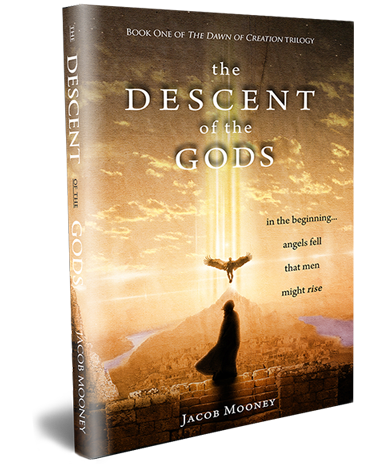
If you want to explore how this strange pre-Flood story has been retold imaginatively while staying rooted in Scripture, I’ve spent more than 15 years developing a novel and screenplay based on Genesis 6, The Descent of the Gods (thedescentofthegods.com). And if you’re looking for a clear, biblically grounded introduction to the “sons of God” and giants in Genesis 6 from a conservative evangelical perspective, Tim Chaffey’s Fallen: The Sons of God and the Nephilim is an excellent starting point (Amazon link).
For deeper, source-based study of Genesis 6, the largest online database of ancient sources on this story and our curated research papers are designed to help you move beyond speculation into careful, historically informed exegesis.