Origins and History
Enoch is mentioned in the Bible’s Book of Genesis as the father of Methuselah and the grandfather of Noah. He is said to have lived for 365 years before God escorted him into heaven. The book attributed to him is a series of texts believed to have been written by several Jewish authors during the course of two or three centuries. The work is considered to be pseudepigraphal, or writing that is falsely attributed to another, more famous author. Researchers believe the earliest sections of the book originated sometime in the third century B.C.E. after the Jews returned to Israel from exile in Babylon. Other parts of the book are thought to have been written in the first and second centuries B.C.E.

The Book of Enoch is the oldest known Jewish work not included in the Bible, although it was mentioned in two books that were—Ecclesiastes and the Epistle of Jude. The book was held in high regard among early Christians and influenced many of the works of the New Testament. The term Son of Man, a title used to describe Jesus as the messiah in other biblical works, was first used in the Book of Enoch. Despite its popularity among Christians, the book was never included in any official church canon, and by the end of the fourth century C.E., it was considered heretical and condemned by the church. By about the year 500, it was believed lost.
The book survived, however, in Africa, where members of the Ethiopian Tewahedo Christian Church believed it to be divinely inspired scripture and incorporated it into their version of the Bible. About the time it fell out of favor in the Roman world, Ethiopian Christians translated it into their religious language and preserved history’s only complete copy. The book was “rediscovered” in the eighteenth century and sparked a revival of interest among European scholars. In 1947, fragments of the Book of Enoch were discovered in a cave in the Israeli desert near the Dead Sea. Known as the Dead Sea Scrolls, the discovery supported the idea that the book had been written over a long period and its earliest sections originated at least as far back as the third century B.C.E.
What Were Enoch and Similar Books Trying to Do with Genesis 6 and the Nephilim?
When we say “Enoch,” we usually mean 1 Enoch, a collection of Jewish writings that claim to record visions given to the patriarch Enoch from Genesis 5. Closely related are Jubilees and the Book of Giants (found among the Dead Sea Scrolls). These are part of what scholars call Second Temple pseudepigrapha—Jewish works written between roughly the 3rd and 1st centuries BC, falsely ascribed to ancient figures like Enoch to give them weight. You can see a basic scholarly overview of 1 Enoch here.
These books all do one main thing: they expand Genesis 6:1–4—the “sons of God,” “daughters of men,” and the Nephilim—and connect that short, strange passage to a much bigger story about evil, spiritual rebellion, and God’s judgment. For a broader introduction to how Genesis 6 fits into the Bible’s giant traditions, see the Tracing the Giants overview series.
In these writings:
- The “sons of God” become Watchers, rebel heavenly beings.
- Their children become giants who wreck the world.
- Their sin helps explain the flood, the spread of wickedness, and even demons.
Theologically, they try to answer questions like: Where did all this evil come from? Why is the world so violent and corrupt? How will God judge wickedness and vindicate the faithful?

Pastorally, they aim to warn compromised leaders and communities, encourage faithful Jews under foreign rule, and strengthen identity in a world dominated by pagan empires. They arose after the exile, when Jews had come back from Babylon but lived under Persian, then Greek, then Roman pressure. They watched temple corruption, cultural compromise, and oppression. Enochic writings use Genesis 6 to talk about all of that.
But they are not Scripture. They are background and commentary, human attempts to wrestle with God’s Word and with wider mythic traditions. They can help us understand how Jews in Jesus’ day read Genesis 6 and the Nephilim, but only the canonical Bible—Genesis, Jude, 2 Peter, and the rest—is our final authority. For a concise evangelical overview of Enoch’s background and purpose, see this summary of the Book of Enoch.
How 1 Enoch Re-Tells Genesis 6: Sons of God, Watchers, and Nephilim
Genesis 6:1–4 is very short:
“When man began to multiply on the face of the land and daughters were born to them, the sons of God saw that the daughters of man were attractive. And they took as their wives any they chose.
Then the LORD said, ‘My Spirit shall not abide in man forever, for he is flesh: his days shall be 120 years.’
The Nephilim were on the earth in those days, and also afterward, when the sons of God came in to the daughters of man and they bore children to them. These were the mighty men who were of old, the men of renown.” (Genesis 6:1–4, ESV)
It raises huge questions but gives very few answers. Who are the sons of God? Who are the Nephilim? How does this connect to the flood? Why does evil escalate so quickly?
Ancient Jewish writers did not leave it there. 1 Enoch 1–16, often called the Book of the Watchers, is the fullest expansion. It shows how Second Temple Jews connected Genesis 6, the Nephilim, and the origin of evil. For a more technical treatment, see discussions like “The Temple According to 1 Enoch” in BYU Studies Quarterly or Loren Stuckenbruck’s work in our research section.
The Descent of the Watchers and the Birth of the Giants
In 1 Enoch, a group of 200 heavenly beings, called Watchers (from an Aramaic word meaning “those who are awake” or “watchful”), decide to descend to earth. Their leader is often named Semihazah (or Semyaza); another key figure is Azazel. They descend on Mount Hermon, swear an oath together so none can back out, and each takes a human woman. This is read as the explanation of Genesis 6’s “sons of God” taking “daughters of men.” A helpful overview of how Enoch develops this Watcher tradition is available here.
From these unions come giants—violent, enormous, and corrupt. They devour the earth’s resources, turn to bloodshed and even cannibalism, and spread chaos across the world. At the same time, the Watchers teach humanity forbidden knowledge: metallurgy and weapons (turning technology into tools of war), cosmetics and jewelry (linked to seduction and vanity), and sorcery, enchantments, astrology, and divination.
This is not a blanket rejection of technology or beauty. It is a way of saying: the dark, destructive parts of culture—warfare, idolatry, occult practices, sexual corruption—came from rebellious heavenly beings misusing gifts that belong to God. In this retelling, evil does not come only from Adam and Eve’s sin in Genesis 3. It also comes from a second rebellion—this time, not just on earth, but with heavenly beings stepping out of bounds.
If you want to explore how other Second Temple texts tell similar stories, the Sources database on Chasing the Giants collects the largest online set of ancient references to the Watchers, Nephilim, and biblical giants.
Judgment, Imprisoned Angels, and New Testament Echoes
In 1 Enoch, people cry out under the violence of the giants. God sends a decree that the giants will destroy one another, and he sentences the Watchers to be bound in darkness until the final judgment. That storyline is exactly the kind of background Jude and Peter assume.
- Jude 6, 14–15 speaks of “angels who did not stay within their own position of authority, but left their proper dwelling” and then quotes 1 Enoch 1:9 directly.
- 2 Peter 2:4–5 says God “did not spare angels when they sinned, but cast them into hell [Tartarus]… if he did not spare the ancient world, but preserved Noah.”
- 1 Peter 3:19–20 refers to “spirits in prison” who were disobedient “in the days of Noah.”
You do not need 1 Enoch to understand these verses, but knowing Enoch’s storyline explains why Peter and Jude can mention imprisoned angels and expect readers to track with it. For a survey of how New Testament writers engaged Enoch, see this article in Kesher Journal on Enoch’s history and New Testament role.
Other Second Temple works pick up the same thread:
- Jubilees retells Genesis and agrees that heavenly beings sinned, though it emphasizes human responsibility more strongly.
- The Book of Giants (from Qumran) focuses on the dreams and fears of the giants themselves.
- Qumran texts like the Damascus Document explicitly connect the sin of the Watchers with the existence of giants.
Together, they show that expanding Genesis 6 into a full-blown cosmic rebellion story was not fringe. It was a common way many Jews before Jesus explained the origin of evil and made sense of the flood.
Scripture itself is brief. Enoch and related works are interpretive expansions, not inspired history. But they help us see how early Jews—and later, the apostles—were thinking when they read Genesis 6, the sons of God, and the Nephilim. If you want to go deeper into academic treatments of these interpretations, our research papers section gathers peer-reviewed studies and theses, including work like this graduate thesis on Enochic traditions and evil.
Why Use Enoch’s Name? Watchers, Identity, and Second Temple Crisis
These books were not written by the historical Enoch. No scholar or serious Bible teacher believes that.
They are pseudepigrapha, works “falsely ascribed” to a famous ancient figure. That sounds deceptive to us, but in the ancient world it was a known literary device. The question is: why Enoch?
Enoch as Ideal Heavenly Mediator
Genesis 5:21–24 says:
“Enoch walked with God, and he was not, for God took him.”
The Bible gives almost no detail, but that one line paints Enoch as deeply faithful and taken into God’s presence without seeing ordinary death. For Second Temple Jews, Enoch became the perfect candidate for receiving heavenly secrets, moving between heaven and earth, and explaining mysteries that Genesis mentions but does not unpack.
So if you want to talk about heavenly courts, rebellious angels, cosmic judgment, and temple imagery, Enoch is the obvious narrative “host.” Scholars like those writing for BYU Studies trace how Enoch functions as a kind of heavenly priest and scribe, reinforcing that role.
Critiquing Corrupt Leadership and Culture
Many Enochic texts, especially later parts of 1 Enoch, do more than expand Genesis 6. They also critique Israel’s own leadership.
The Animal Apocalypse (1 Enoch 85–90) tells Israel’s history with animals standing in for nations and leaders. Many scholars see it as a veiled attack on corrupt priests and rulers in Jerusalem, especially before and during the Maccabean period. The priests who should guard holiness are quietly cast as failed shepherds, more like the Watchers than like faithful servants of God.
This fits with biblical critiques of failed leadership in texts like Malachi 2 and Ezekiel 34. The Enochic writers are doing something similar, but in apocalyptic, symbolic language that also engages with surrounding myths. For a concise overview aimed at lay readers, see this Renew.org article on Enoch’s background and purpose.
Strengthening Jewish Identity Under Hellenistic Pressure
These books were also written when Jews faced intense Hellenistic pressure—Greek language, philosophy, religion, and lifestyle pressing in on every side.
By telling stories where heavenly beings fall through lust and compromise, and where giants bring violence and corruption, Enochic texts send a message to real communities: do not be seduced by the “great ones” of the nations. Don’t follow corrupt leaders who make peace with idols. Hold fast to God; judgment on wicked powers and false shepherds is coming.
Jude 14–15 taps this very function when he quotes 1 Enoch to warn about false teachers:
“Behold, the Lord comes with ten thousands of his holy ones,
to execute judgment on all and to convict all the ungodly…” (from 1 Enoch 1:9)
Jude can quote Enoch here because the warning is true, even though the book as a whole is not canonical. For more on how Jewish and early Christian interpreters used Enoch, see our commentators and sources pages.
If Enoch Was So Influential, Why Isn’t the Book of Enoch in the Bible?
The EBSCO Research Starter on the Book of Enoch notes that 1 Enoch is “the oldest known Jewish work not included in the Bible,” and that it was highly regarded among early Christians. It influenced New Testament language about judgment scenes, heavenly books, and especially the title “Son of Man” used for Jesus.
EBSCO explains that the “Son of Man” language appears in developed form in 1 Enoch before the time of Christ. Yet, despite this influence, Enoch was never universally accepted as Scripture.
Canon, Dating, and Pseudepigraphy
Biblical books were recognized, not declared, as canonical. The early church and earlier Jewish communities read many texts and even quoted some non-biblical works, but consistently treated a limited set of writings as the inspired standard for worship, doctrine, and life. Enoch never achieved that status across the board.
Reasons include:
- Composite authorship and late dating. EBSCO notes that 1 Enoch is a collection of five main sections, written by multiple Jewish authors over “two or three centuries,” with the earliest parts around the third century BC and later parts into the first century BC.
- Pseudepigraphal nature. Everyone knew it was not actually written by Enoch from Genesis 5.
- Doctrinal and speculative elements that go beyond or conflict with the rest of Scripture—especially detailed angelology and the fate of spirits.
By the 4th century AD, most of the church regarded Enoch as non-canonical, and by about AD 500 it was largely “believed lost” in the wider Christian world. Articles like this Kesher Journal study trace that process in more detail.
Ethiopia, Dead Sea Scrolls, and Rediscovery
The story does not end there. The Ethiopian Tewahedo Church translated 1 Enoch into Ge’ez and included it in their wider canon. EBSCO explains that Ethiopian Christians preserved “history’s only complete copy,” treating it as divinely inspired scripture in their tradition.
In the 18th century, European scholars “rediscovered” Enoch through Ethiopic manuscripts, sparking renewed interest. In 1947, fragments of 1 Enoch in Aramaic and Greek were found among the Dead Sea Scrolls, confirming that these writings were widely known among Jews before Jesus.

So why is Enoch not in most Bibles today? Because, despite its influence and value, neither mainstream Judaism nor the majority of early Christian communities ever embraced it as inspired on the level of Genesis, Isaiah, or the Gospels. The right stance today is balanced: we should not build doctrine on Enoch, but we can still read it as helpful context, especially for understanding Jude, 2 Peter, and how Second Temple Jews thought about Genesis 6, the sons of God, and the Nephilim.
If you’re interested in a biblically grounded introduction to Genesis 6 from an evangelical perspective, Tim Chaffey’s Fallen: The Sons of God and the Nephilim is one of the best entry points.
How Enochic Literature Should (and Shouldn’t) Shape Our View of Christ and Scripture
Used rightly, Enoch and similar books can sharpen, not weaken, our trust in the Bible and our focus on Jesus.
Enochic literature, at its best, pushes us to take seriously the unseen realm, the reality of rebellious spiritual powers, and the gravity of sin and judgment. It says loudly what the Bible also says: evil is not just “bad systems” or human mistakes. There are cosmic rebels as well as human rebels, and God will judge both. The New Testament confirms this in passages like Ephesians 6:12 and Colossians 2:15.
At the same time, the New Testament does something Enoch never fully does: it brings everything to a sharp, clear center in Jesus Christ. In Enoch, the main drama is often heavenly beings versus God, giants versus humanity, and visions of judgment. In the New Testament, the main drama is the Son of God versus sin, death, and the powers, with the cross and resurrection as the decisive victory.
Hebrews 1–2 emphasizes that the Son is superior to angels, heir of all things, and the One through whom the world was made. Where the “sons of God” in Genesis 6 left their proper domain in rebellion, Jesus, the true Son, leaves His place in humble obedience (Philippians 2:6–8). The failed sons corrupt humanity. The faithful Son redeems humanity.
That is why we must be careful not to turn Enoch into a hidden codebook, or to base our demonology or end-times views mainly on non-canonical texts. The New Testament does not invite us to be obsessed with giants. It invites us to be captivated by Christ.
If you are curious about the myths and conspiracies that often grow up around Genesis 6—Nephilim DNA, giant skeletons, aliens, and more—the Debunking category on Chasing the Giants offers level-headed responses: Debunking sensationalist claims about Genesis 6:1–4.
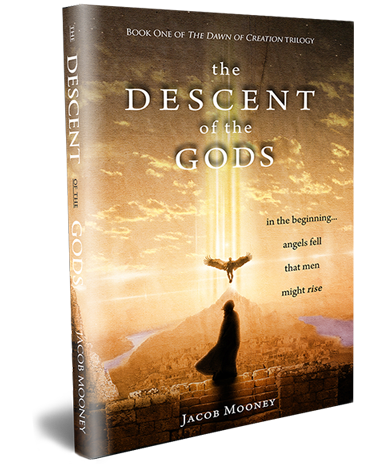
If you want to see how these themes can be explored imaginatively yet responsibly, my novel and screenplay The Descent of the Gods is one attempt to retell the Genesis 6 story without leaving biblical boundaries.
Conclusion: Why the Book of Enoch Exists—and Why Christ Stands Above It
We can say this:
Why was the Book of Enoch written?
To wrestle with Genesis 6, the sons of God, and the Nephilim; to explain where evil came from; to connect spiritual rebellion with the flood; and to speak into Israel’s real crises—corrupt leaders, cultural pressure, and the longing for God’s justice. It also reworks wider Near Eastern myths in a Jewish monotheistic framework.
What was it trying to do?
It expanded the brief, cryptic story of the “sons of God” and Nephilim into a full cosmic drama of Watchers, giants, and judgment. It warned the unfaithful, comforted the faithful, and strengthened identity in a confusing, hostile world. It gave theological and pastoral shape to questions that Genesis 6 only hints at.
What is it not?
It is not Scripture. It is not a rival revelation. It is not a secret key that unlocks what the Bible “really” means. It is a human, pre-Christian attempt to read Genesis carefully and imaginatively—sometimes helpfully, sometimes speculatively.
Many details remain uncertain: how much of Enoch’s narrative is literal history, and how much is theological imagination; exactly how the Watchers’ sin unfolded; in what sense the Nephilim were “giants,” and how much of later giant lore reflects real events versus cultural memory. The Bible does not fill in all those blanks.
It gives us enough to know this: there has been rebellion in heaven and on earth. God has judged and will judge that rebellion. Above every failed “son of God,” one true Son stands, who came not to corrupt but to save.
So study Genesis 6. Read Enoch if you want to understand how ancient Jews thought. Explore the sources and research if that helps you. But let Scripture set the guardrails and let Jesus Christ—crucified, risen, and coming again—remain at the very center.
That is where the Bible itself points, and
That is where the Bible itself points, and that is where real hope is found.